

Early Detection in Storage and Transshipment
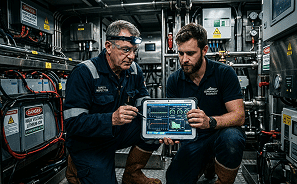
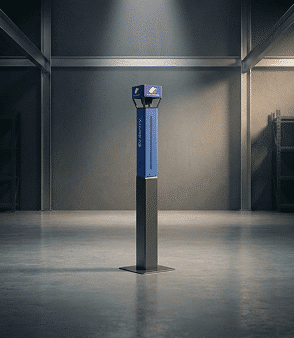
Thermal monitoring and smart detection help identify anomalies in incoming shipments, return shipments, and temporary storage of lithium-containing goods.
TRANSPORTATION & LOGISTICS
Lithium hazards in transportation and logistics often arise in places where speed and volume converge. Think of warehouses where packages containing batteries arrive, are sorted, are temporarily stored, or are shipped out immediately. At such times, it is difficult to know exactly which lithium-containing shipments are present, what condition they are in, and what risk they pose.
In addition, damaged batteries, improperly packaged returns, or incorrectly charged batteries can behave unpredictably. An incident may start small, but in a busy logistics environment, it can quickly impact employees, equipment, the flow of goods, and business continuity. That is precisely why transporting lithium requires an approach that goes beyond standard fire safety measures.
In a logistics environment, shipments, locations, and risk profiles are constantly changing. As a result, lithium fire safety is not only a technical issue but also an operational challenge. A conventional evacuation or fire suppression plan often fails to adequately account for thermal runaway, smoke generation, reignition, and the speed at which an incident can spread among packages or cargo streams.
Effective management therefore requires early detection, clear procedures, and facilities that are suited to docks, storage areas, return flows, and internal transportation. This is the only way to maintain control over safety, operational continuity, and the requirements that insurers and regulatory agencies are increasingly imposing.

Lorem ipsum dolor sit amet, consectetur adipiscing elit. Nulla elementum et urna id placerat. Vivamus lacinia, diam nec...
View solution
Lorem ipsum dolor sit amet, consectetur adipiscing elit. Nulla elementum et urna id placerat. Vivamus lacinia, diam nec...
View solution