The Cost of Waiting: 10 Lithium-Ion Fires That Should Change the Way We Think About Prevention

The Cost of Waiting: 10 Lithium-Ion Fires That Should Change the Way We Think About Prevention
17/08/2026

The Cost of Waiting: 10 Lithium-Ion Fires That Should Change the Way We Think About Prevention

What if preventing a €100,000, €500,000 or even multi-million-euro fire started with an investment of only a few hundred or a few thousand euros?

July 2026 alone gave us another uncomfortable reminder of how deeply lithium-ion batteries have become embedded in our everyday lives.

Homes. Hotels. Workshops. Recycling facilities. Waste trucks. Commercial buildings. Battery Energy Storage Systems.

Different environments. Different battery sizes.

But the same underlying challenge:

When a lithium-ion battery fails, a very small event can become a very large incident remarkably quickly.

And the latest research published in July and August makes the case for prevention even stronger.

An August 2026 scientific review of NMC lithium-ion battery fires compiled 53 fire tests and 32 off-gas datasets. Depending on the failure mechanism, peak heat release exceeded 300 kW per kWh of battery capacity in some scenarios.

Separate experimental research into e-scooter fires demonstrated just how little time can be available: in one residential experiment, flashover occurred within approximately 30 seconds after visible smoke.

That changes the question.

It should no longer be:

“How do we extinguish a lithium battery once it is fully involved?”

It should be:

“How do we stop it from ever getting that far?”
 

10 recent fires worth looking at

Below are ten publicly reported incidents from July 2026 that illustrate the scale and variety of the problem.

  1. E-bike & e-scooter workshop — Walworth, London

On 12 July, around 60 firefighters and eight fire engines attended a fire at an e-bike and e-scooter workshop.

The building was destroyed and approximately 35 people were evacuated from neighbouring properties.

Investigators believe the cause was the catastrophic failure of a lithium-ion e-scooter battery.

Potential loss exposure: €250,000–€1m+ depending on building, equipment, stock, interruption and neighbouring damage.

Possible prevention scope: battery segregation, fire-resistant charging/storage, early off-gas detection and automatic local suppression.

Indicative Liiontek-scale investment: from several hundred euros for local battery protection to several thousand or tens of thousands for a fully monitored facility.

The difference is fundamental:

Protect the battery before the building becomes the fire compartment.


  1. 1.5 MW BESS — Bautzen, Germany

On 21 July, a 1.5 MW lithium battery storage facility consisting of four containers caught fire in Bautzen.

Firefighters had to continuously cool the installation because of the ongoing risk associated with the batteries. The cause had not yet been established when the incident was reported.

Historic BESS data demonstrates why these incidents deserve attention. FDNY training material references 23 South Korean ESS fires with system losses exceeding $32 million, an average system loss of roughly $1.4 million per incident, although individual losses varied considerably.

Potential exposure: easily €1m+ for larger installations once equipment, interruption and consequential losses are included.

Prevention scope: continuous off-gas and thermal monitoring, compartmentalisation, automatic suppression and escalation management.

Liiontek currently offers technologies such as Li-Ion Tamer Gen 3, publicly listed at approximately €10,000, alongside other detection and suppression solutions.

That puts prevention into perspective.

€10,000 detection technology versus potentially seven-figure losses.


  1. Recycling centre — Wimbledon Park, London

On 18 July, approximately 80 tonnes of household waste became involved in a recycling-centre fire.

The most probable cause was a lithium-ion battery.

Four fire engines and around 25 firefighters responded.

This is not an isolated problem.

UK industry research reports more than 1,200 battery-related fires annually in waste vehicles and facilities. Zurich UK has reported individual claims reaching approximately £20 million.

More recent parliamentary evidence states that the economic impact of battery-related fires in the UK waste sector may now exceed £1 billion annually.

Potential exposure: hundreds of thousands to several million euros for a serious facility fire.

Prevention scope: intelligent thermal detection, early-warning systems, monitored quarantine areas, automatic suppression and dedicated battery containment.

This sector cannot realistically guarantee that batteries will never enter the waste stream.

It therefore needs systems designed around the assumption that eventually, one will.


  1. Waste transfer facility — Southwark, London

On 13 July, approximately 40 firefighters and six fire engines responded to a lithium-ion battery fire inside a waste bay.

The fire occurred in a pile of waste inside the facility.

This is precisely where early detection matters.

A battery beginning to fail within tonnes of combustible material may initially represent only a tiny heat source.

Minutes later, the entire surrounding waste stream can become fuel.

Possible Liiontek approach: thermal monitoring combined with automatic warning and targeted intervention before large-scale propagation occurs.

Compare thousands spent on detection with hundreds of thousands, or potentially millions, spent recovering from a major recycling fire.


  1. Waste facility — Edmonton, London

On 16 July, a failing lithium-ion battery inside a power bank reportedly ignited approximately four tonnes of general waste.

Four fire engines and around 25 firefighters responded.

Think about that relationship for a moment.

A battery worth perhaps tens of euros.

Four tonnes of material involved.

Twenty-five firefighters.

Almost two hours of emergency response.

The size of the battery does not determine the size of the eventual loss.

The surrounding environment does.


  1. House fire — Beckton, London

On 14 July, a lithium-ion battery failure caused a house fire that damaged part of the first floor and roof.

One vehicle was completely destroyed, another vehicle was damaged, and the roof of the neighbouring property was also affected.

Six people were assessed by emergency services.

Potential loss exposure: €100,000–€500,000+ once property, vehicles, temporary accommodation and neighbouring damage are considered.

Now compare that with some very simple preventive options.

Liiontek publicly lists:

  • Fire Extinguishing Pad: €120,-
  • E-bike Home Charging Safety Kit: €493.56
  • Lithium Fire Garage Kit: approximately €396.82
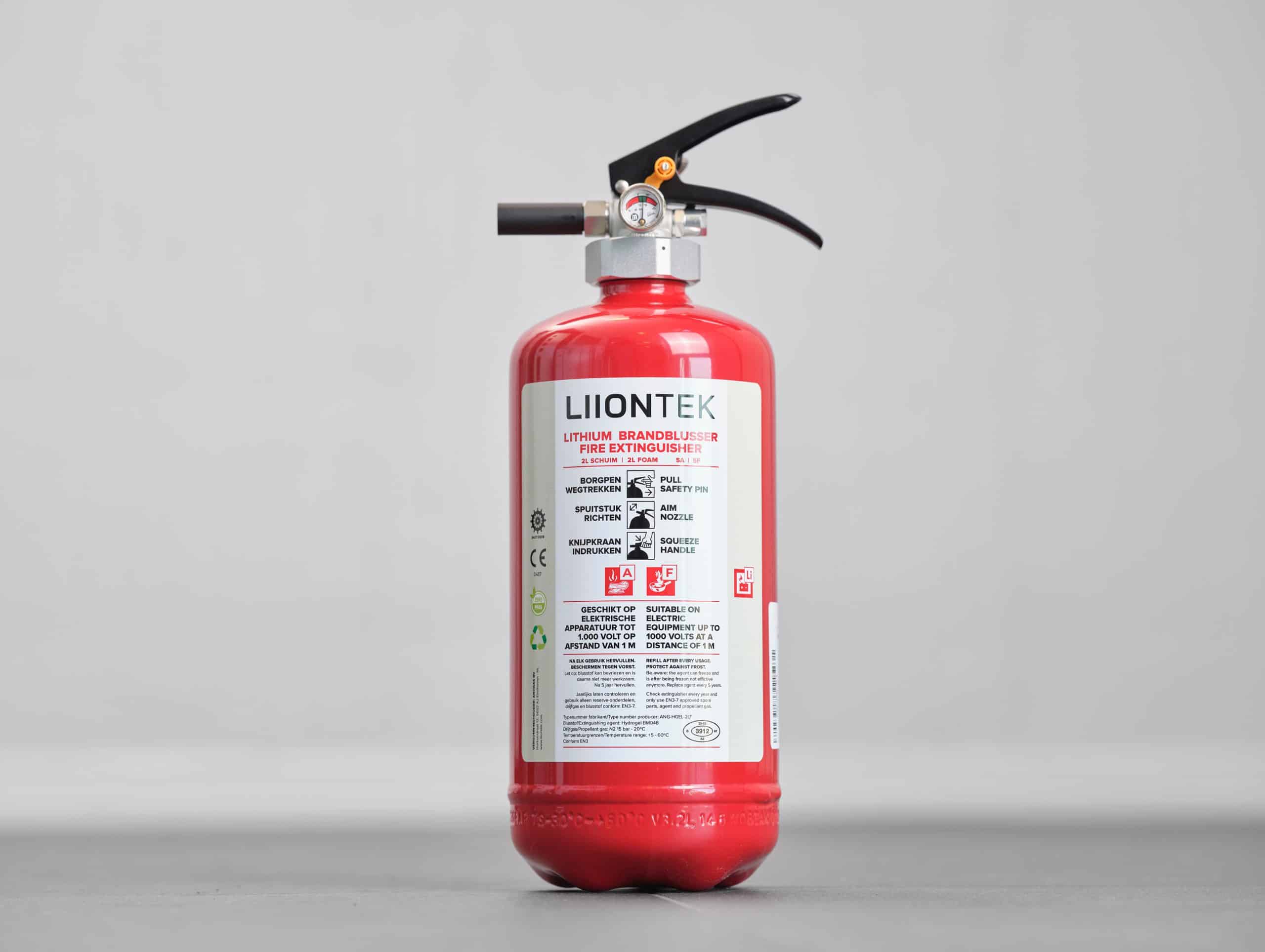
  • 6L ASAPs lithium fire extinguisher: €160,-

This is where the prevention discussion becomes difficult to ignore.

A few hundred euros versus potentially losing part of your home.


  1. High-rise e-bike fire — Scarborough, Toronto

On 12 July, an e-bike battery caused a two-alarm fire in a residential high-rise.

Heavy smoke spread through the second floor and three people from neighbouring units were transported to hospital.

This illustrates one of the most overlooked lithium-ion hazards:

the battery does not need to belong to you to become your problem.

In apartment buildings, hotels, student accommodation and care facilities, one person’s battery can expose dozens, or hundreds, of other occupants.

Prevention therefore cannot rely entirely on user behaviour.

Safe charging locations, containment, detection and automatic intervention have to become part of building design.


  1. Hotel fire — Kingston upon Thames

On 20 July, a lithium-ion e-bike battery caused a fire inside a hotel.

A first-floor hotel room was destroyed and two people were taken to hospital.

For a hotel, the financial impact goes far beyond replacing one room.

There may be:

room closure,

smoke remediation,

lost bookings,

evacuation,

business interruption,

insurance costs,

and reputational damage.

A dedicated safe charging or storage location costing a fraction of the potential incident should increasingly be viewed as basic infrastructure, not optional equipment.


  1. Residential fire — St. Johns County, Florida

On 15 July, firefighters responded at approximately 02:15 to a major garage fire believed to have originated from an e-bike being charged.

Five children and two dogs escaped safely.

The homeowner described the house as majorly damaged, although firefighters prevented the fire from spreading even further.

The family reportedly had charged the bike in that location for around two years without a previous problem.

That detail matters.

Lithium safety cannot be based on:

“It has always been fine.”

Past performance does not guarantee that an individual cell will never fail.


  1. Power-bank fire — Maida Vale, London

On 18 July, a power bank being charged caused a fire in a residential property.

Part of the ground-floor flat was damaged, the ceiling of the lower-ground floor flat collapsed and two people were taken to hospital.

Again, the original energy source was tiny compared with the eventual consequence.

A power bank.

A collapsed ceiling.

Two hospitalisations.

This is exactly why lithium-ion risk needs to be treated differently from the value of the device itself.


So what does prevention actually cost?

This is perhaps the most important part of the conversation.

People frequently assume lithium fire protection means a complicated €50,000 or €100,000 installation.

Sometimes a sophisticated engineered system is required.

Often it isn’t.

Depending on the application, Liiontek solutions currently range from approximately:

€36 for a small ASAPs extinguisher,

€121 for automatic Fire Extinguishing Pads or Wire,

around €400–€500 for residential charging/fire-safety packages,

approximately €1,150 for thermal lithium-fire detection,

to approximately €10,000 for Li-Ion Tamer early off-gas detection.

Larger automatic suppression, battery containment and engineered industrial systems are naturally project-specific.

But even then, the principle remains the same:

Prevention usually costs a fraction of the incident it is designed to prevent.

UK industry sources cite an average lithium-battery fire insurance claim of around £50,000, with severe incidents exceeding £400,000.

In waste and recycling, individual insurance claims have reportedly reached approximately £20 million.

Against those numbers, spending hundreds, thousands or tens of thousands on prevention starts to look very different.


The industry needs to move from fire control to fire prevention

There will always be a place for firefighting equipment.

But once thermal runaway has fully developed, the problem has already become considerably more difficult.

Modern lithium safety should therefore use multiple layers:

Prevent abnormal battery conditions wherever possible.

Detect the earliest warning signals, including abnormal temperature and battery off-gassing.

Isolate the affected battery from surrounding combustible material.

Suppress the incident locally before propagation occurs.

Protect people from heat, toxic gases and secondary exposure.

Contain a battery that cannot safely be removed.

This is the philosophy behind Liiontek.

We don’t believe the future of lithium-ion safety is simply about finding a bigger extinguisher.

We believe it is about detecting smaller problems earlier.

The cheapest fire is the one that never starts

Perhaps the most revealing thing about July’s incidents is not their size.

It is their variety.

A power bank.

An e-bike.

An e-scooter.

A battery hidden inside household waste.

A 1.5 MW BESS.

The battery sizes are completely different.

The principle is identical.

A small failure can become a very large loss when there is nothing between the failing cell and its surroundings.

So here is our challenge to every homeowner, facility manager, safety professional, insurer, recycling company, logistics operator and business owner:

Find the lithium-ion battery in your environment that could create your biggest problem.

Then ask yourself:

What would it cost me if that battery failed tonight?

And then:

What would it cost to prevent that incident today?

The difference between those two numbers may surprise you.

At Liiontek, that is exactly the conversation we want to have.

Not:

“Which product can we sell you?”

But:

“What is your lithium risk, and how can we prevent it from becoming a fire?”

Because prevention is not an expense measured against the price of a battery.

It should be measured against the loss that never happened.

Protecting People. Preserving Business.

https://liiontek.com/products/

18 August 2026

The Benefit Of Spending € 500 On Lithium Protection

09 April 2026

“Li-Ion brandblusser kopen? Bescherm je woning en bedrijf tegen lithium brand.”

09 April 2026

“Thuisbatterij brandgevaar: risico’s, richtlijnen en 5 veiligheidstips.”