
contact


“Why MGN-681 Chapter 4 should not be seen as a box-ticking exercise, but as a framework to actively reduce risk, here’s what that means in practice.”

‘The goal is not simply to contain failure, it is to prevent it.’
Why the industry rather hides behind the institutions, instead of taking safety seriously.’
‘We need a type approval. But why is that so relevant?’
‘Do you have a type approval?’ But for what exactly?’
These are the normal and sometime typical questions we’ve had during our over 200 surveys we’ve completed in the last years. The question are valid, especially in the beginning when the first yachts caught fire due to lithium. Several companies stood up, quickly crafted storage solutions and without any guidance just supplied them to quite some vessels over the last years. It did depend who we spoke with on board, we had examples where a captains weren’t interested because they didn’t see the possible issues but where the crew stood up to meet us, or situations where we met a crew which came recently on board since their previous vessel burned down, they just want to make sure it won’t happen again.
I’ve written this article to explain what this updated Amendment 1 of the MGN really is about but I’m basing this article on real experience on board. All solutions we provide to the industry are simply the best ones available, the issue is, some of these solutions are not type approved yet since they are generations ahead of the updated MGN version. We’ve been part of the initial review of the MGN-681 back in 2021-2022 and some of the updates we recommended back then are now taken into the update. So the companies creating new technology are years ahead of the legislation.
Lithium-ion systems are rapidly becoming standard onboard modern vessels, but they introduce a fundamentally different risk profile that is still not fully understood across the industry.
Why is the market only talking about having a type approval, while this doesn’t give you anything in terms of on board safety, and compliance?
With the introduction of MGN 681 Amendment 1, important steps have been made. At the same time, we see a growing tendency to interpret compliance as safety, and to focus on isolated solutions rather than the full system.
I wrote this article to bring clarity from a practical, real-world perspective. Not just what is required, but what works onboard. And what can avoid incidents that are pretended not to exist.
Because in lithium-ion safety, compliance is only the starting point.
Why reading only chapter 4 of MGN 681 amendment 1 is not enough.
MGN 681 Amendment 1 is an important and welcome development for the yachting industry. It recognizes that lithium-ion powered tenders, jet skis, water toys and spare batteries introduce a fundamentally different risk profile from traditional fuel-powered equipment. The guidance makes clear that safety onboard must address fire prevention, storage, detection and suppression as a complete system.
However, there is a growing misconception that simply complying with Chapter 4, particularly through the use of a type approved storage or charging cabinet, is enough to create a safe onboard environment.
That is not the case.
Why Chapter 4 has become stricter, and why that matters.
To understand this properly, it is important to look at why Chapter 4 has become more prescriptive.
The increased focus on defined requirements and Type Approval is, in part, a response to the market conditions of recent years. The yachting industry has seen a wide range of storage and charging solutions introduced, not all of which have met acceptable safety standards. Inconsistent engineering approaches, unclear performance claims, and in some cases fundamentally unsafe products have led to a need for clearer rules and stronger validation.
From that perspective, the move toward type approval is both logical and necessary. It introduces accountability, establishes a baseline for safety, and helps owners, captains and shipyards navigate what has historically been a fragmented market. This is something we fully support.
However, there is an important nuance.
Type approval against Chapter 4 demonstrates compliance with a defined set of criteria, primarily focused on containment, structural integrity, ventilation and response to failure. What does not automatically guarantee is that a product delivers the highest level of safety in practice, particularly when it comes to prevention, early detection or system integration.
This creates a critical gap. A product may be fully compliant, and Type Approved yet still be less effective in preventing an incident than a more advanced, prevention-led solution that may not (yet) sit within that specific approval framework.
That is why independent expertise matters.
At Liiontek, we position ourselves as a specialist advisor, not a product-driven supplier. Our approach is unbiased and focused on real-world safety outcomes. That means we support type approved solutions where appropriate, but we are equally transparent when a non-Type Approved solution may offer a higher level of safety due to earlier detection, stronger prevention mechanisms or better integration with onboard systems.
Compliance is important, but it should never be mistaken for the highest possible safety standard.
Chapter 5: type approval, important, but not yet mandatory.
Chapter 5 introduces type approval for storage and charging solutions, and it represents an important step forward for the industry.
We strongly support the introduction of type approval. It brings structure, consistency and a clearer benchmark for safety in a market that has historically seen a wide variation in product quality and performance. Establishing defined testing and approval pathways helps raise the overall standard and provides reassurance to owners, captains and shipyards.
At the same time, it is important to understand how this requirement is currently applied.
Type approval is not mandatory for all installations until 01-01-2027. This means that many systems already installed onboard yachts are not subject to these approval requirements. As a result, there is currently a mix of solutions in operation, ranging from newer systems aligned with emerging standards to legacy installations developed under earlier practices.
This transitional phase is a natural part of the industry evolving.
It is also worth noting that MGN 681 remains a guidance document, not a formal legal requirement. It has played a key role in advancing lithium-ion safety awareness and setting direction for the sector, which is a very positive development. At the same time, like any guidance, it continues to evolve and should be interpreted as part of a broader safety framework rather than as a complete or final solution.
Type approval, therefore, should be seen as an important component within that framework, but not the only measure of safety. True onboard safety is achieved through a combination of compliant products, system integration, early detection, prevention strategies and correct operational procedures.
Why a system-based testing approach such as UL 9540A matters
If the industry is serious about moving toward prevention and real-world safety, it also needs to reconsider how solutions are evaluated.
This is where a system-level test such as UL 9540A (6th edition) becomes highly relevant.
Unlike more traditional approval pathways that may focus on individual components or specific functional requirements (such as containment or ventilation), UL 9540A evaluates how a lithium-ion system behaves under failure conditions. It looks at thermal runaway propagation, heat release, gas generation, flame spread and the effectiveness of mitigation strategies within a complete system.
This aligns much more closely with how lithium-ion incidents develop in reality. This is a much more mature way of testing this storage & charging solution than for example with a UL 1487, this is a used test for ‘passive’ box/containers. These tests are mainly there for thermal runaway situations. This still means that with such approved systems you still need to wait for fire to start before this box starts to act.
Thermal runaway is not a single-component issue, it is a system failure. It involves interactions between cells, modules, enclosures, ventilation, detection systems and suppression measures. Testing that focuses only on isolated features cannot fully capture this complexity.
A system-based test approach reflects:
- How failure initiates at cell level
- How it propagates through a battery or storage environment
- How gases are generated and managed
- How detection and suppression systems perform together
- Whether escalation is prevented or merely contained
In many ways, this approach is closer to the original intent behind MGN 681: treating lithium-ion safety as a holistic onboard system, not as a collection of independent compliance points.
It also reinforces a key point: true safety is not defined by whether a product survives a test, it is defined by whether the system prevents escalation in the first place.
As industries evolve, we believe system-level validation methods such as UL 9540A should play a larger role in decision-making. They provide a more realistic understanding of risk and performance, and they better support a prevention-led safety philosophy.
Concerns around approval consistency and decision-making.
Another important concern within the industry is not just what is approved, but how approvals are being granted.
In practice, we are seeing inconsistencies between vessels operating under the same flag and class. In some cases, one vessel is required to install a Type Approved lithium-ion storage or charging solution or is not permitted to carry such equipment at all. In other cases, vessels under the same regulatory framework have been allowed to use standard lockers or non-specialized spaces as “approved” lithium-ion storage.
This inconsistency raises serious concerns.
Lithium-ion battery risks are complex, fast-developing and still relatively new to the maritime sector. Assessing what constitutes a safe solution requires specialist knowledge of battery failure modes, thermal runaway behavior, gas generation, and system integration. It is not an area where subjective interpretation or case-by-case judgment should play a dominant role without clear technical grounding.
When approval decisions vary significantly depending on the individual assessor, surveyor or interpretation of guidelines, it creates uncertainty across the industry, and more importantly, it creates uneven levels of safety onboard.
In our view, there should be a more consistent and technically robust approval process. Clear standards, applied uniformly, are essential. The current situation, where similar vessels receive different approvals for fundamentally different levels of protection, is not aligned with the level of risk lithium-ion technology introduces.
The limitation of a Chapter 4-only approach.
Chapter 4 plays an important role, but by design it is largely reactive.
It focuses on storage and charging arrangements, fire-rated boundaries, ventilation, shutdown systems and the management of off-gases. These are all essential elements, but they are primarily intended to respond to an incident once it has already begun to develop.
Even ventilation requirements are framed around maintaining gas concentrations below explosive limits after off gassing has started. Fire suppression measures are designed to control or extinguish an event that is already underway.
This is not prevention. This is containment and damage limitation.
That distinction is critical because lithium-ion incidents escalate rapidly. Once thermal runaway begins, it becomes extremely difficult to control. Batteries can continue to generate heat without external oxygen, re-ignite after suppression, and produce toxic and flammable gases.
A system that only reacts at this stage is already operating too late in the failure curve.
Why are Chapters 6, 7, 8 and 9 crucial?
To truly understand onboard safety, the focus must shift to the earlier chapters of intervention and system design.
Chapter 6: Battery Management Systems (BMS)
It is fundamental because it introduces monitoring and intervention before failure escalates. A BMS can track current, voltage, individual cell behavior and temperature, and initiate countermeasures such as isolating faults or disconnecting the battery. Crucially, MGN 681 recommends integration with the vessel’s alarm and monitoring systems. This is the foundation of prevention.
Chapter 7: Fire Detection and Alarm
Build on this by emphasizing early recognition. Smoke, heat and gas detection, CCTV monitoring, remote alarms and even thermal imaging are all part of creating visibility before a situation becomes critical. The mention of off-gas detection, even as a developing technology, is particularly important, as it signals a move toward identifying failure at its earliest stages.
Chapter 8: Fire Suppression
Highlights the complexity of lithium-ion incidents. Water-based systems, water mist, portable extinguishers, fire blankets and containment solutions are all required because no single method is sufficient. The explicit warning about re-ignition reinforces that suppression is not a one-step solution, but part of a layered safety strategy.
Chapter 9: Crew Training
It is the final and often underestimated element. Crew must be able to recognize damaged batteries, understand warning signs, and respond correctly. Without this, even the best technical systems can fail in practice.
Together, these chapters define a safety philosophy that goes far beyond storage. They define a system.
Why prevention-led systems deserve more attention.
This is also where the current guidance still leaves room for improvement.
MGN 681 acknowledges early detection technologies, but it does not strongly push the industry toward prevention-first solutions. As a result, many products on the market are still designed to react to heat, smoke or fire rather than to intervene before thermal runaway develops.
This is where solutions such as the Schneider Containment Generation 4 (SC-4 platform) represent a different approach. These systems are described as being engineered to prevent thermal runaway before they begin, using ultra-sensitive single-cell detection, active ventilation, filtration, automated countermeasures and integrated alarm systems.
This shifts the role of the cabinet from passive containment to active prevention.
That difference is fundamental.
A Type Approval based solely on Chapter 4 demonstrates compliance with containment and response requirements. It does not demonstrate that a system provides the earliest possible detection or the strongest prevention capability. As such, it should be seen as a baseline, not a benchmark for the highest level of safety.
Installation quality is just as important as product quality.
Even the most advanced system can be compromised if it is not installed and integrated correctly.
MGN 681 treats lithium-ion safety as a vessel-wide system involving ventilation, alarm integration, firefighting arrangements and control systems. Products such as the SC-4 platform are also designed with integration in mind.
If these systems are poorly installed, incorrectly ventilated, or not properly connected to onboard monitoring and alarm infrastructure, their effectiveness can be significantly reduced. Early warnings may not reach the right location, suppression systems may not act as intended, and ventilation may not perform under real conditions.
In practice, poor installation can undermine even the highest quality product.
The real takeaway.
MGN 681 Amendment 1 should not be read as a checklist that ends at Chapter 4.
Chapter 4 is important, but it is only one part of the safety equation. True onboard safety comes from combining prevention (Chapter 6), early detection (Chapter 7), effective suppression (Chapter 8) and trained human response (Chapter 9), all supported by correct installation and system integration.
The industry should be careful not to confuse “Type Approved” with “Safest Possible Solution.”
For lithium-ion risks onboard vessels, the goal is not simply to contain failure.
It is to prevent it.
Liiontek stands ready, not as a follower of regulations, but as a leader in prevention.
Because heroes do not wait for disaster.
They engineer a future where disaster never gets the chance.
Ontdek meer nieuws
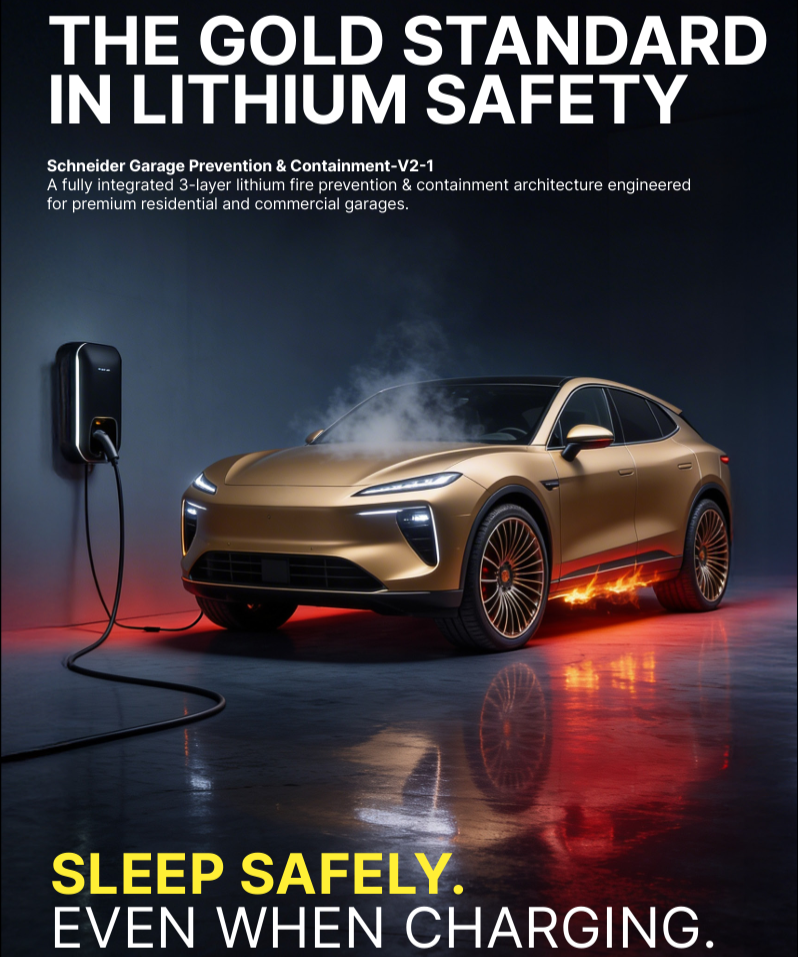
Li-Ion powered vehicles in garages, high-end residential, datacenters and logistics.

MGN 681 (M) Amendment 1: Turning Lithium-Ion Fire Safety Guidance into Practical Action on Yachts
 English (UK)
  Nederlands